Showing posts with label sensors. Show all posts

Wednesday, November 11, 2015

Monitor access to buildings

Access to barns and recording the access is more important today than ever before.  Biosecurity and monitoring labor are just two of the reasons it makes sense to have a basic understanding of the coming and goings of people at the farm site.  I have put together using a basic door sensor a system that can provide quite a bit of insight into a farm's activity and compare to other similar farm's activity for benchmarking purposes.

Certainly I realize that this is a fairly low-cost monitoring system.  Undeniably there are bigger and better ways to monitor exactly who is coming and going and at exactly what time.  You could retina or fingerprint scan workers like 007 movies but at what cost?  You could have card scanners but then look at the expense of installing that for one or two workers.  What if they forget their card or lose it?  Often the "home office" is far away and the logistics of getting a new card could take days.  Or a substitute needs to go to the site who doesn't have a card?  A simple low-cost employee monitoring device could be the solution.

Here is what I did.

I installed a simple door sensor that sends a count of how many seconds the door is open in 5 minute intervals for each time it is opened.  That information is then sent to Grovestreams where I am doing some simple analysis with it that provides me with some excellent information.

Data #1.  I get the first time of the day that the door was opened up.  This is huge.  If the employee is supposed to be at the site at 6am and they regularly arrive at 9am that is a problem.  


The image above shows activity on a system that monitors a door at my office.  Grovestreams allows for an easy way to determine the first and last timestamp of activity received for the day and shows it in a dashboard.

In addition I can take the last timestamp and subtract the first and get an estimate of the time the site was occupied for the day.  

I also chart this for quick viewing (guess I haven't been to the office at all in the last few days):


Interesting alerts on this.

1.  Send an alert to email or phone on the first arrival every day.

2.  Send an alert to email or phone on activity outside of a time filtered period.  Example send an alert for every activity outside the hours of 6am to 6pm.

3.  Send an email at 12:01am if the duration of the previous day was less than 4 hours.

4.  Same alert as #3 except for exclude weekends.


Expanded analysis:

Many sites have multiple barns.  As part of the Multisense sensor gateway users could add door sensors to each barn entrance and managers could track how much time is spent in each of the barns on the site.  Alerts for barn doors left open would be simple to include as part of any package as well.

Grovestreams and Multisense make prototyping IoT projects simple and low cost.  This door sensor project took me hardly any time or money and now I think this could be used in barns all around to monitor employee time.

Wednesday, October 7, 2015

Bin Sensors Help Order Feed

Talk to any feed mill operator and they will tell you that the biggest issues that affect their efficiency all surround feed ordering.  Too many orders on Mondays and Fridays, missed orders that result in emergency deliveries after hours all have produced many grey hairs amongst feed mill staffers.

The Binlogic bin sensor provides some good data which can help feed mills know or predict when bins are empty and need a delivery scheduled.  As this goes to press, we are still working on refining and improving the sensor but initial data is promising.

Installing even more sensors as well as predictive growth software can provide a lot of contextual information to effectively put a feed ordering program together for an entire feed mill system.

Some ways this can work:

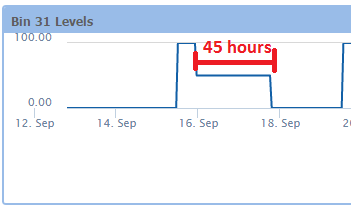
Utilize 1 high sensor and 1 low sensor.  This is a great way to know a time frame from when a bin begins to be depleted until it is in the cone and more feed can be delivered.  In the example below a trigger can be set for as soon as the sensor in the high goes from closed to open to put a feed order in for 45 hours later.


Furthermore, many sites use tandem bins.  The example below shows that from the time that bin 31 starts going down to the time that bin 32 goes below cone is 96 hours.  So, in this case a date range of between 45 and 96 hours from the time bin 31 first goes down could be pushed to the mill as a delivery window to ensure the site doesn't run out of feed.


Another strategy would be to look at these 2 time spans for the order window.


This strategy would call for a feed delivery from 66 hours to 119 hours from the time Bin 31 first starts to go down to ensure feed doesn't run out.

Even another strategy would be to send a notification to the feed mill as soon as a bin goes empty which triggers an order to drop and go out within X hours.  If the feed mill has a queue of empty feed bins for which to deliver feed against it could make for an efficient system.

Yet another option would be to simply have a single high sensor and as soon as the feed went below the sensor an order was placed for X days from that moment.  The days could be calculated based upon assumed consumption for animals of that size/age etc.

All of these strategies can be modeled in Grovestreams and passed into any feed mill software.

As with any of the sensors a full suite of intelligent alerting is available.  Example: Receive notification when a bin goes below a certain level, feed is ordered but hasn't arrived, intake is faster/slower than the assumed order rate among many others.

Much work is still needed on using these bin sensors to accurately order feed.  Initial results have shown promise.  Combining bin sensors with many other sensors ensures even better data and automation at a livestock site.

Monday, September 7, 2015

Sensor Spotlight: Poultry Scale

Poultry scales are not new technology for chicken or turkey producers to incorporate in their live production operations.  Weighing birds has many advantages throughout the supply chain starting in the live production area (nutrition, vet services, etc) to finished production planning, sales and marketing and accounting.  Many stakeholders in a poultry production system have a need for accurate, timely live weights in the barn.

The average weight itself has some limit to its value.  It is valuable to understand nutrition and other factors from a learning and KPI standpoint.  The more frequent weights and accurate, frequent, surrounding data the more learning and improvement a system can gain.  What producers really want is an estimate of when a weight that triggers an event (like marketing) is going to be obtained.  Example: in 4 days the weight should be 6 pounds.  This is the crucial information needed for planning within an organization.

A quick google search shows many poultry scale options.  Any follower of this blog will know that FarmStreams is all about getting the data off the farm and into the cloud where it can be accessed and consumed by the users who need the information but are not going to the farm every day.

The FarmWeight VEIT Bat2 scale is a scale we have had success implementing with the FarmHub patform.  If a producer is already invested in a different type of scale a retrofit is possible; but this is one that we have successfully connected to the cloud and is ready to install today.


It offers the following features.

1.  Wireless connectivity to Grovestreams data platform.  Which can in turn be pushed into an enterprise system.

2.  Network multiple scales over a single connection point at a site.

3.  24/7 monitoring and reporting of the following:
a. average weight (male & female)
b. weight gain
c. number of samples

4. Alerting if certain weight related thresholds occur.  The thresholds can be variable and change with other data or time passing.

5. Data allows a producer to predict market dates.

Beyond just the single data points related to bird weights integrating with feed data, temperature, water usage and other data surrounding the environment of the barn in real-time in a powerful analytics engine like Grovestreams allows producers to glean new information to improve processes even further.

Similar to the other sensors, the data is valuable on its own as discussed above and can have even greater value as part of a larger more complex analytics program on the farm.

Wednesday, September 2, 2015

Invest in process improvement not band-aids

Technology enables improved process management.  Process management is the antidote to common issues in the industry.  Often times producers will take steps to reduce issues by dealing with the symptoms of the problem.  For example, installing larger feed bins or bigger feeders on the site.  That can help reduce problems but won't solve and is massively more expensive than implementing process-focused technology.  Livestock farming is one of many industries that can adopt M2M / IoT systems to improve existing processes in an organized and meaningful way.

Some ways we are doing this is with:

Within the industry commonly approaches to deal with issues are to go bigger.  For example, when feed bins running out of feed it is often suggested to spend the capital to upgrade to larger feed bins on the site.  When digging into the results of this investment - often results are a mixed bag.  It is nearly as common for feed to run out when larger feed bins are used as smaller ones.  Barn workers have a false sense of security with all that feed capacity on site and the bins run out even in tandem.  Or both slides are left open and both bins run open catching the worker by surprise.  It happens frequently.  If the process isn't fixed, the problem isn't fixed.

I have been at a layer facility where tandem bins 36 tons each were sitting within the line of sight of the feed mill no more than 1/2 mile away.  The bins would run empty and be waiting on feed from the mill.  

That much capacity also makes it very difficult for industries, like egg layers, who might want to change nutrition quickly to do so.  You have to go through 4 days of feed before you can change the ration when that much is on site.

More feed capacity inside the barn is another common solution to feed outages.  Without a doubt it is helpful but expensive.  It also doesn't guarantee that there are not times when feed is not flowing and that bunk is not full.  

One last comment, process improvement and band-aids come in waves.  Process improvements made today will make waves that result in even more process improvements in the future.  Band-aids work the same way, a 24 ton bin today becomes 36 tons in a few years.  You have to keep making the band-aid bigger and bigger, they don't get smaller.

Thursday, August 27, 2015

More feed line problems (setting delay timers)

Once we start gathering more and more feed data and keeping in the store we can go back and look at some interesting things.  We have already posted about alerts to solve feed problems, such as feed outages, bin rotations, and feed ordering, and what we can do to help solve them. This morning I decided to go back and look at frequency of feed events and discovered some alarming problems which we went over this morning with the site owner and are fixing.

In my analysis, I found that on some feed lines, the Feedmeter was reporting feed events very frequently, sometimes every minute.  See the underlying data in the store below:


In 18 minutes, we reported 16 feed events.  When I roll up the data to a day and also look at the sum, average, sample count I see the following data.


Several issues for us to work through here.

1.  At that small of a run time the Feedmeter is set up to fail.  A key variable in the Feedmeter's algorithm is the run time.  If a setting is off causing the start to end run time to be off by 0.25 seconds, it is rounding error on a 60 second run; but catastrophic on a 1.25 second run.  The Feedmeter's ability to estimate intake is not optimal.

2.  Feed motor life expectancy is slightly reduced for every time the motor runs.  A motor that runs 500 times a day versus 50 times a day probably will go bad much faster.  I did a quick inquiry with some equipment sales guys in town and a typical motor life is 5-6 years and costs $225 to replace.  Moisture (see future blog post about humidity sensors), feed quality and frequency of running will cause them to go bad faster.  

3.  Feed motors failing cause feed outages.  Without a full suite of monitoring it is easy not to recognize this problem until it is later than you would like.  By the time it is fixed, the feed outage has likely cost you money and hurt your animals.

So how does it happen?  Its a tough job and barn workers forget about it.  Perhaps a line didn't start in the past and the barn worker blames the delay timer and shuts it off.  There is a lot of things to train and its possible the barn worker was never trained in how to use the delay timers.

We could set alerts around delay timers if we wanted to it would be very easy.  Simply take the current value's timestamp in the store minus the previous value's timestamp in the store and see if it exceeds a minimum delay timer value.  If it doesn't send an alert.  I always hate having pointless, repetitive low-value alerts so I would be more prone to having a once a week check.  Grovestreams does a very good job of allowing you to add unlimited intelligence to the alerting engine.  Perhaps in this case put in the software to look at the average time between feed runs for the past week or count the total feed runs and alert if it exceeds a certain value.  

In addition, monitor your whole site for feed.  If a barn worker is worried about the line starting up on a delay timer we have an alert for that out of the box.  

In conclusion, putting a cost on improper settings on a feed line is nearly impossible and not that large in the grand scheme of things.  The bigger issue is the cost of poor on-site management to livestock operations.  If barn workers are not setting delay timers properly it is an indication of poor management which likely have bigger ramifications throughout that site's production.

Wednesday, August 26, 2015

Monitoring employee's time - Trust but Verify

Ask most livestock producers what the biggest difference between a high performing site and a low performing site and they would tell you the on-farm labor.  Sites with good managers perform well, sites with poor management perform poorly.  FarmStreams entire business exists because of this fact.  Drilling deeper a good indicator of management quality would be the amount of time an employee is on the site.  A 45 minute walk-through and leave is going to have different results than a site that has an employee on site for 10 hours each day.  Its just common sense.

One of the benefits of using FarmStreams is that we can watch over all of the systems for a farm worker while they are gone in a much more intelligent way than the existing alarm systems in the marketplace.  Its almost like extending the management time on a site with software and advanced automation instead of a person.  Its a tough concept to embrace; but it can really be true particularly in systems where the labor force is stretched thin or even the supervisor level is stretched thin allowing workers to take shortcuts because they know that they have a good chance of getting away with it.

So what is our solution?

First, monitor the entire site to ensure all systems are working at all times.  We talk about this at length in the blog and will continue talking about ways we do this.

In addition, install sensors such as door sensors or motion detectors in common areas.  Collect the information and transmit it to the cloud via the MultiSense sensor gateway.  The calculations would be very easy.  Last timestamp in epoch millis minus the first timestamp in epoch milis converted to a decimal hour should be a pretty accurate time on site.  The full suite of alerts for an upper manager would be available.  Less than a certain threshold triggers an alert.  Fully customizable.  Also the full reporting/dashboard graphs would also be available.

I have had personal experience with some barn workers and its often hard to believe them as much as I want to.  When we have feed problems on the site they are never there.  They left an hour ago.  They weren't planning to come until 3pm today, whatever the situation might be 9am or 6pm the story is the same.  Like any business you have good employees and you have bad employees.  I would not say that me calling them and them not being near the site means they are bad.  It could be coincidence.  However if the monitoring sensor kept track of human activity on the site each day you now have a way to go back and know what is going on with that employees time.

As one industry exec recently told me.  Trust, but Verify

Wednesday, August 19, 2015

Sensor Spotlight: Temperature

Air temperature is a very important measurement in hog and poultry barns around the world, impacting animal health, feed consumption and growth.  Every single barn controller system I am aware of has temperature readings which control various heating/cooling/ventilation equipment to maintain the optimal temperature within the barn.  Most of these controller systems either do not store the information or keep it locally which is not helpful for analytics.  Many producers also likely pay for an alerting service which temperature is likely a variable that is alerted upon if it is too high or too low.

Logging the temperature data in the cloud can be very valuable.  By connecting an existing controller to a cloud service like Grovestreams (which will be possible with the MultiSense Plus soon to be available) or by installing independent temperature sensors you now have that data logged forever.  You can simply produce charts which show the temperature over time, the average/high/low for a day over time or a variety of display options.  This is generally easy stuff for most data platforms to handle.  GroveStreams does it well; but so do others.


What we can do in FarmStreams using the GroveStreams platform is far more in-depth.  

One area is in the alerting engine.  Most alert systems are set up to be very simple.  Is it higher than a high threshold, call.  If its lower than a low threshold call.  A basic alert protocol in our alerting engine could be to set different thresholds based on the age of the animal.  At day 7, 92 degrees is the high threshold, at day 60, 84 degrees is the high threshold.  Other more involved alerts could include feed intake, if temperature is below 50 degrees in the barn and the animals have consumed over 6 pounds of feed in the last 24 hours.  That also could be a sliding scale: ex 3 pounds when they are 7 days old, 6 pounds when they are 67 days old.  It could be an alert based upon a percentage over or below budget also tied to temperature.  I am not saying these are practical alerts to execute; just showcasing how complex an alert condition could be set up as in our platform.

In addition to the more in-depth alerts we also can do some real interesting analytics with all of the data points.  Since we have accurate hourly intake information we can easily compare very granular actual versus budget for different temperature levels.  We can use time-filters to look at consumption at different times of the day actual vs budget across an entire system for different temperature levels in the barn.  I am not suggesting this is a priority task to do today or even next year.  As we have documented earlier, simple execution of feed orders and bin switching are low-hanging fruit to tackle now.  But for hardcore analytics like myself, it is easy to see how when a major livestock production system decides to adopt a Big Data IoT initiative the separation from the pack will be swift.  The way in which this industry leader will separate is through the process verification tools, like we have been talking about on the blog - which impacts things on the monitoring and total quality management side; but also from the robust and powerful analytics engine like GroveStreams on the data benchmarking side.  In my humble opinion this will quickly separate them as a low-cost, high-quality producer.

In conclusion, capturing and storing temperature data is very easy.  It is a very important part of hog and poultry operations in terms of animal health, feed intake and growth.  FarmStreams can 
  • capture the information down to the second if so desired, 
  • store it, 
  • send it to your enterprise level system as a raw value or calculated value at customized intervals, 
  • chart it, 
  • perform simple or complex alerts, 
  • engage in some hardcore analytics/benchmarking (in real time).  
In a data hungry industry this is far superior to sitting on a controller in the barn.  In my next blog post I will show how we created another weaker (but cheaper) solution for uploading the data via the FarmStreams mobile app.

Sunday, August 16, 2015

Sensor Spotlight: Water Meters

Most of our discussion so far has been on the feed side of livestock agriculture: ordering properly, feed outages, feed budgets and overall execution of the feed side.  There is a lot of money left on the table in feed execution for a typical livestock producer, that is my belief.  Water consumption and air quality are right up there.  Water is something that can be monitored fairly easily and is growing in importance in a world that is more concerned about its water resources than ever before.  Monitoring can provide actionable alerts with payback as well as provide a lot of insight into animal health and should be a key performance indicator.

Basic Water Monitoring.

There are many different types of water meters in the market today.  Every barn I have been in has a water meter with a gallon count.  Most barn workers are required to write down the water reading each day, subtract from the previous day and attempt to keep track of daily water usage on a piece of paper at the barn.  Many water flow meters come with a digital, or pulse output, which can then be connected to a Multisense gateway and sent into the cloud.

Alerts.

Once the water reading is sent to the cloud it passes through the customize-able alert engine to determine if an alert condition has been met with the individual piece of data.  Furthermore, Grovestreams allows alert conditions to be set as data is aggregated, calculated or whatever you might wish to do with the data over time.  For example, a standard alert condition that I have set up for each water monitoring install is at 1201am, I look at the previous day total water / animal vs the previous 5 days average.  If that total is 90% or less or 110% or more it triggers an email alert.

I have not set it up; but a user could also check this total at different points of the day, perhaps at 10am it could be compared to the previous 5 days midnight to 10am total / animal.  Again at 4pm and finally at midnight.

A user may also wish to trigger an alert condition when so much water is flowing it can only be attributed to a leak.  If water consumption spikes > 500% in a given hour compared to the average hour.  Or if the barn manager wants to know if 50 gallons or more is recorded in an hour all of those alerts could be set up around water usage.

A 5 day water / animal average chart is shown below.  One day on Aug 4 there was a drop in water consumption by 9%.  I am not sure the cause.  Otherwise, most days have shown a 3-5% increase from the previous day.


Many users wish to see the data in a column chart versus the previous X days.  That can look something like this.  Or we can put it in a dashboard ready for viewing at any given time.


Payback opportunities.

With water there are quite a few payback opportunities that arise from having solid monitoring and analytics programs around it.  A few worth pointing out.

1.  Manure level and quality.  Water leaks or poor nipple settings that result in large quantities of water in the manure pit or on the poultry side in the litter can have costly consequences.

a.  With swine, having to empty a pit in the spring time is not ideal.  Even if a spring pumping is avoided, extra gallons to pump can add up.  Pumping manure pits is estimated to cost 1-2 cents per gallon.   50,000 additional gallons of water in the pit can cost $500-1000 annually.  Plus crop producers want to pay for nutrients, not water.  Diluted manure can be harmful to maximizing the value of your manure.

b.  With poultry, wet litter causes increased ammonia levels and a worse environment for the bird.  This can be costly to the production costs.

2.   Drops in water consumption can help a producer detect health challenges in a group.  Any tools that help detect health issues sooner can result in big savings for that group of animals.

3.  A serious malfunction like a well pump failure or leak that results in animals not getting water for a period of time can be very costly just like a feed outage can be.  The sooner that type of problem is identified and water is restored to the animals the more productive the animals will be.

Water meters themselves are not expensive.  Connecting them to the cloud/internet can be.  Installing water meters in addition to other sensors, such as bin sensors and feed line sensors is incrementally low-cost.

In conclusion, water meters are a proven well known technology.  Connecting them to the cloud and putting heavy analytics to the data is a logical next step for animal agriculture.  Particularly when water use in agriculture is a growing concern in many parts of the world.  Alerts that allow barn workers to fix leaked or broken water lines quickly can save money.  Trends that suggest health challenges can alert veterinarians to sick animals before it is too late.

Thursday, August 13, 2015

Sensor Spotlight: Feedmeter

Many years ago, Feedlogic began development of a feed line sensor with the purpose of estimating feed flowing through a standard auger line.  The way that it works is that a box with a sensor, small computer and a wireless RF communication chip is strapped to any size auger line between the feed line coming into the building and the first drop.  This is a very durable device with Feedmeters that have been in barns for over 3 years still working as they did when they were installed.  An image of the Feedmeter is shown below.


The Feedmeter can

1.  Fairly accurately estimate the duration of feed events, especially events that are longer than 10 seconds.
2.  Estimate feed weight delivered by event.
3.  Alert a user to a feed related problem.

How does FarmStreams use and improve the information from this sensor in our system?

1.  Upon arrival we pass each data point through our robust alerting engine.  Alert conditions are customizable by user; but the key ones are going to be around feed outages and then some of the analytics comparing actual feed usage to budget.

2.  Based upon other streams - mostly software streams (budget information) and BinLogic bin level sensor streams we can calibrate the weight data in the cloud, improving accuracy.

3.  The estimated feed intake predicts when feed orders will need to be placed.  Software can place the orders or a person reviewing the data can place the orders.

4.  Create actual intake curves and compare them to a customizable budget threshold curve.


5.  Estimate average weight of the animal and compare to a budgeted weight.  A future sensor spotlight will focus on scales that can be integrated with FarmStreams.


In conclusion, the Feedmeter can provide at its very basic level a very good alerting tool for feed problems.  Most experts believe that feed outages are the biggest contributor to poor ADG and feed conversion.  The reasons for the feed outages vary but the first step is knowing about them, recording them and fixing them as they happen.  Not all sites have these problems; but sites that do should strongly consider installing Feedmeters to get a handle on the situation.  In addition to the immediate alerting functionality, the Feedmeter provides the analytic guys a whole wealth of information in real time that can be used to improve processes within the system.  I would strongly recommend installing both the Feedmeter and BinLogic simultaneously for maximum accuracy in the data.  As Peter Drucker often said - "If you can't measure it, you can't improve it."

Tuesday, August 11, 2015

Ordering feed can get complex...fast!

One of the hog sites we are monitoring with the FarmStreams sensors and mobile app program is a 3 barn, 6 group site.  Each of the three barns is split in the middle to make 6 groups.  Each of the 6 groups has a set of tandem bins delivering feed to two feed lines in each group.  Total of 12 feed bins, total of 12 feed lines.

The barn worker at the site has been ordering the feed aggressively as we documented in a previous post.  The typical routine has been to order a half load (12T) for 1 of the bins on each side of a building.  Example, Bldg 1, East Side (12T) + Bldg 1, West Side (12T).  Bldg 2 orders always get grouped, and bldg 3 orders always get grouped.

We are only 6 weeks (42 days) into the turn and the feed inventory is already flipped upside down.  It can happen very fast.  Bldg 3 east side has 1 bin empty, and Bldg 3 west side is essentially full with both bins.  The software is accurate as was attested by the barn manager in a physical inventory taken earlier today.


How does this happen?

1.  Placements of animals is uneven in the groups.
2.  A group hit harder with mortalities or health challenges can also throw intake projections.
3.  Average weight of the animals starting is not the same between the groups.
4.  Poor feed ordering.  Feed deliveries when their is not room in the intended bin results in the truck dropping feed in other bins.
5.  Pigs, chickens and turkeys can eat differently.  Perhaps the environment is different or the feed quality differs between groups.
6.  Feed delivery trucks can make mistakes and feed that everyone thinks ends up in a bin can end up in a different bin all together or back at the feed mill.

So, why is this a problem or who cares?

1.  When the bins get out of whack it is more difficult to keep track of.  No one ever wants to run out of feed so there is a tendency to over-order feed.
2.  It is also very easy for the bin getting depleted much faster to run out of feed too quickly leaving the site with a set of bins out of feed for a period of time.
3.  Delivering feed on feed can cause flow issues.
4.  Delivering feed on feed can cause the nutrition plan to not be executed as well as planned.
5.  For companies keen on analytics, having this information available in a robust database to

What is the solution?

Use the BinLogic sensors and feed line sensors to keep track of inventory.  Integrate with feed mill software to ensure accurate and timely deliveries.

Friday, August 7, 2015

Sensor spotlight: BinLogic feed bin level sensor

BinLogic is a bin level sensor that is valuable for managing feed inventory in the FarmStreams feed inventory system.  There are many other types of bin level sensors such as ultrasonic, load cells among others.  Our focus is really about getting data streams out of the farm site into the cloud analytics engine and/or an enterprise level system.  So, we could integrate with other bin level sensors and are willing to do that if a farm feels very strongly or has already invested heavily in another type of sensor.  With that said, our preference right now is the BinLogic sensor because it is low cost and effective to help tell a user remotely when a bin needs a feed order.

The BinLogic sensor is very simple device.  It provides a boolean (1 or 0) output.  1 is when feed is covering it and 0 is when feed is not covering it.  My preference is to put two sensors in each feed bin.  One at the top and one at the cone.  A user could put several in each bin for improved accuracy or a single sensor at a single level.  A picture of two sensors from the top of the bin is shown here.


We encountered some initial issues with ratholing when the center sensor was down the center of the bin causing false empty readings.  We moved the lower sensor off from the sensor and that has largely eliminated false empty readings.  A 2nd lower sensor on the opposite side would eliminate false empty readings.  Software also is very important in interpreting the data.  A single top sensor combined with other information like population, age and especially a feed line sensor to estimate feed flow is also a very tidy effective solution to order feed accurately.

Primary benefits to BinLogic Sensor:
  1. Send alerts to specific users when thresholds are met, triggering feed orders.
  2. Provide an off-site party ability to easily see inventory levels on the farm.  People such as feed mill personnel, managers, or the barn worker.
  3. Provide managers / nutritionists verification their nutrition plan is being executed.  Tandem bins are being switched, in order and on time.
  4. When combined with other sensors and software streams effectively keep track of inventory and feed consumption.
  5. Calibrate other sensors such as the feed line sensor in the cloud based on actual feed disappearance over time, improving the sensor's future accuracy.
  6. Feed inventory values at specific timestamps to create very accurate feed curve charts.  Track vs budget.
  7. Timestamp bin fill events to ensure feed is delivered to the correct bin at the right time.
  8. Ensure there is room for feed in the bins when the truck leaves the mill.
  9. Reduce need to climb bins improving safety and employee morale.
The BinLogic sensor is a valuable tool to manage feed ordering and ALSO provide very valuable feed intake data for your analytics.  All stored and accessible indefinitely in real time.  Provide alerts around the analytics or deliver meaningful, customizable reports to management on a schedule or on the fly to correspond with site visits.  Benchmark your performance internally or externally if you choose.  The sky is the limit...and it all starts with a simple bin sensor.